Showing posts with label distress ink. Show all posts

Wednesday, December 4, 2019

winter's light

December days are shorter as darkness settles in early and makes for long evenings.
It is so nice to put out the Christmas decorations as we begin to celebrate this wonderful season.
During these times, I love the warm glow that candlelight provides. I thought it would be fun to create a winter lantern, using die cut greens and the Gypsy Soul Laser Cut lantern cage style.
Today I am on the GSLC blog, sharing "winter's light."
The finished lantern measures approximately 3-1/2" square x 6-1/2" high. It arrives flat in 10 pieces. I like to pre-assemble the pieces before I begin my actual project. This helps me to envision the final piece, as well as understand which parts go where and the best method to put it all together.
When all of the pieces are carefully removed from the surround, use a dry rag or paper towel to wipe down all of the edges. I first paint all of the pieces with black acrylic paint.
When that paint is dry, turn the pieces over and paint the exterior faces of each piece with brushed pewter distress paint. I use a dauber top to apply the paint lightly along the mullions and exposed edges. If you prefer a shinier finish, use two coats of brushed pewter.
When the paint is completely dry, assemble the main part of the lantern. Add a small line of glue along the bottom edge of the side panels and insert the tabs into the openings in the base. I prefer to use tacky glue as it gives me a little extra open time so that I can be sure all of my pieces fit correctly, and if necessary, I am able to make adjustments before that glue has dried. I assemble three sides of the lantern base, as well as the top section. I do not glue down the uppermost top piece or the lantern door. I leave the door as a separate piece so that whatever is placed inside can be easily accessed.
A knob (handle) is added to the lantern top before it is attached to the lantern. To ensure that it is centered on the top, turn the piece over. Draw diagonal lines to opposite corners. Where these lines intersect is the center of the square.
Using a dremel (or an awl) drill a hole, large enough to accommodate the knob screw, directly at the center. Slip the screw through the hole and then screw the knob onto it from the opposite side. Once the knob is secured in place, glue the top onto the lantern.
The lantern is now ready to be adorned. I had many ideas for this piece and decided to keep it simple, thus extending the period that I can leave it out on my shelf. I die cut bunches of various evergreens, then colored them using distress inks and paints.
I create a wreath to attach to the top panel around the knob and some additional greenery pieces are located around the base.  Inside, I place a red (battery operated) candle amongst the greens.
 Note: the GSLC lantern is made from flammable chipboard, do NOT use a traditional candle inside the lantern due to fire hazard
The lantern interior is easily viewed from the exterior. It could reasonably accommodate a snowy Christmas scene inside, or even a mini faux poinsettia plant. The lantern could also be used in a non-holiday fashion; perhaps as a base for a steampunk styled piece. The possibilities for this lantern are endless. I do hope that you have been inspired to create your own lantern cage style.
Thanks so much for stopping by today, I truly appreciate it.
Wishing you a wonderful holiday season,
~Ann
 xxx


supplies:
Distress ink:
crushed olive, evergreen bough, forest moss, mowed lawn, peeled paint, pine needles
Distress paint: brushed pewter, black soot
Dremel
faux pillar candle: red
Gypsy Soul Laser Cuts: Lantern Cage Style
mixed media heavy stock (for die cuts)
pencil
ruler
Scotch 3M tacky glue
Stickles: holiday red
Tim Holtz Ideaology knob
Tim Holtz / Sizzix Alterations:
holiday greens, holiday greens mini, festive greens, funky festive,
large funky festive, wreath and snowflake  

Thursday, October 10, 2019

grateful

If there is one month I associate with the fall season, it has to be October. 
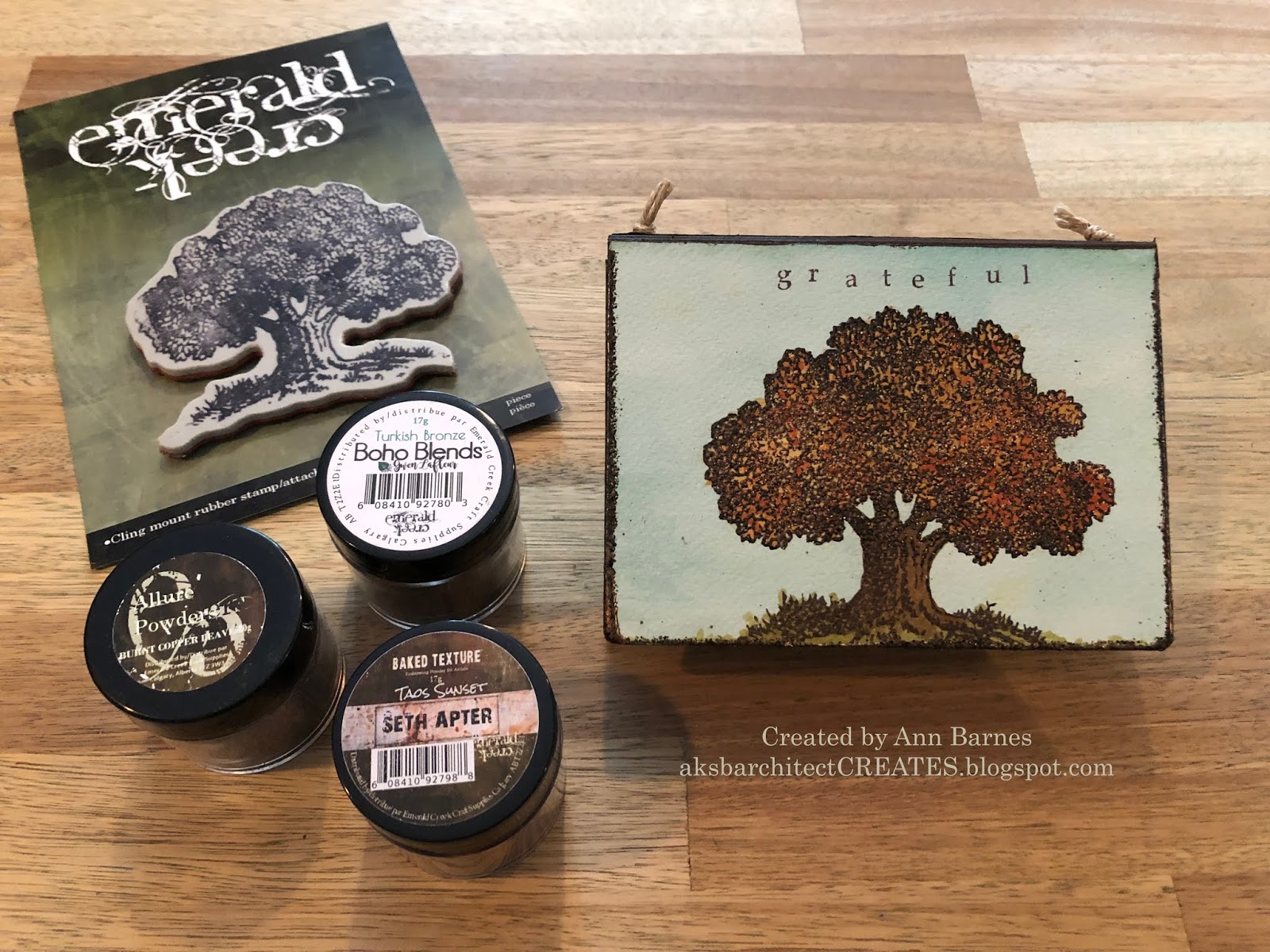
Where I live, this month offers witness to the glory of mother nature by means of an autumnal show of stunning color. We watch as the leaves turn gorgeous shades of golden yellow, bronze, and red, before they are shed in preparation for a winter's lull. As I appreciate all the wonder that is presented to me, it gives me a wonderful opportunity to really give thanks for all that I have. This is the inspiration behind my gratitude journal for the Emerald Creek Dares Challenge this month.
I begin by stamping the Emerald Creek Oak Tree Stamp with Archival ink onto watercolor paper that has been colored with a wash of Distress ink. Using a stamping platform, it is easy to re-stamp the upper portion of the tree with VersaMark embossing ink. 
I sprinkle embossing powders over the leafed section of the tree in a random pattern. I use Turkish Bronze, Taos Sunset, and Burnt Copper Leaves powders; each of which is absolutely beautiful on its own; however, I thought by using a blend of powders, I could achieve the variation that is so typically seen in nature. Once the embossing has cooled, I color the stamped and embossed image of the tree with distress inks. I also stamp the word "grateful" along the top edge. This panel becomes the cover of my gratitude journal. Using my Xyron creative station lite, I add adhesive to the back of the panel, and attach it to the notebook die cut. 
More of the inked watercolor paper is used to create the interior panels for the journal. These pieces are cut to size and then stamped with decaying leaf images with embossing ink. These leaves are coated with Burnt Copper Leaves embossing powder and heat set. When the embossing has cooled, these panels are attached to the interior of the book. 
I run my embossing pad along the sides and bottom of the front cover then add more of the Burnt Copper Leaves Embossing powder and heat set. This creates a wonderful finished edge that coordinates with both the inside and out. 
The back of the gratitude journal is covered in a faux wood paper created using a 3D embossing folder and inks to create a realistic looking (and feeling) panel. Another section of this faux wood runs along the top spine of the journal. 
Paper twine is strung between two eyelets to secure the signature inside. I want the signatures to be removable so that each year I can complete a new month of entries and keep the old ones to look over and know just how filled with blessings my life is.    
One thing I know I am grateful for is all of you, my followers, I appreciate you taking the time to stop by the blog and for all of your wonderful comments.
I hope that you are able to find time this fall to soak in some of the beauty that nature has to offer.
If you have the opportunity to create something fall/Halloween inspired, please consider joining this month's Emerald Creek Dares Challenge.
Thank you so much for stopping by today. 
~Ann
 xxx


I am entering this into the following challenges:


supplies used: 
1/8" eyelets
chipboard
Crop-a-dile tool
Distress Archival ink: ground expresso
Distress inks: 
broken china, brushed corduroy, forest moss, ground expresso, rusty hinge,
 vintage photo, walnut stain,  
Eileen Hull/Sizzix notebook die
Emerald Creek Art Stamps:
Emerald Creek Embossing powders:
paper twine
Tim Holtz/Sizzix 3D Texture Fade lumber
Tim Holtz/Stampers Anonymous leaf prints stamps (CMS273)
Tim Holtz stamping platform
VersMark embossing ink
watercolor paper
Xyron Creative Station Lite

Wednesday, August 7, 2019

tag book trio

Hi everyone, it seems as though the dog days of summer are upon us; I was glad to spend some time in the studio creating this trio of tag books. Gypsy Soul Laser Cuts makes this set of three, extra large heavyweight chipboard tags that were perfect for my project.
Today I am on the Gypsy Soul Laser Cuts Blog sharing this tag book trio.
As I mentioned earlier, the set is comprised of three chipboard decorative tags x-large. Each tag has a distinct shape to the top, which makes each tag book unique.
 
I want to use the hole as part of my closure for each book. I measure from the end of the tag to where I want the base to meet and divide that in half to find my crease point. (Note: since all three tags are a little bit different, it is best to measure each one.)
When I find that center, I use a bone folder and straight edge to score the tag at the crease line. I score both sides and then fold the tag. Next, I select some papers from my stash and cut then to fit the width of the tags, adding a little extra to the length to accommodate the folds. Be sure to cut two pieces for each tag book, one that will serve as the exterior cover, and a second for the inside.
Once all of my papers are cut, I add a strip of linen hinging tape along the outside fold edge. I then ink all of the edges with distress ink. I have used black soot as well as gathered twigs, select inks that coordinate with your decorative papers.
Before I begin attaching my papers, I decide on closures. Each of my tag books utilizes a little different method. Understanding how the books will be closed allows you to add pieces under the cover paper if necessary. Any ties can be glued to the raw tag and this will strengthen the bond.
 Once the closure is settled on, the next step is to attach the interior paper to the tag. I like to use distress collage medium for this. It dries quickly and is not overly wet, so there is not warping of the paper or the tag. Allow the interior decorative paper to dry and trim the decorative edge and hole with an Exacto knife. 
Next, create the internal signatures for your tag book. Each of my tag books has six pages inside. I cut a piece of paper 3 1/8" x 6" and fold at the center of the rectangle. stack the three folded pieces inside one another. Measure an equal distance in from the edges at the fold and pierce through the stacked pages. Align the stacked pages with the interior fold of the tag book. Pierce the cover directly through the existing holes so that the signature will be aligned with the book cover. 

Using a needle and some sort of binding thread (I used fine jute) sew the pages together through the cover and tie together at the outside. It is also a good idea to add the signature to the inside of the tag book prior to the external cover paper. This allows you to hide the binding threads. If that is not important to you, then you can add the signature after the outside cover paper.
With the signature and closure method secure, I add the decorative cover paper to the exterior and allow the adhesive to dry. The edges are trimmed around the decorative edge and the tag book is complete.  I just love the size of these tag books, they are just large enough to stick into a pocket and take with you easily. I made three different tag books with the set of GSLC tags. By simply using different papers, you can achieve very different looks.  
 
 
I just love this trio of tag books and look forward to using them! I think they would also be a lot of fun to create in holiday themes to send to friends. I hope that you are inspired to try some for yourself.
Thank you so much for taking the time to stop by today, 
I truly appreciate it.
Be creative every day.
~Ann


Gypsy Soul Laser Cuts used:
Chipboard Decorative Tags X-Large

other products used:
Distress collage medium: matte
Distress Ink: black soot, gathered twigs
Exacto knife
Lineco: linen hinging tape
MayArts ribbon: string burlap ribbon black
Neenah: creative cardstock naturals
Tim Holtz Ideaology paper stash: dapper, memorabilia, wallflower
Tim Holtz Ideaology trimmings: crinkle ribbon, naturals black and cream
Tim Holtz Ideaology design tape

Wednesday, July 17, 2019

fright night fancies

With all the recent holiday releases from some of my favorite companies, I was inspired to make a Halloween project. I know it is still July; but as a good friend said to me, "Halloween's only three months away!" I have also noticed that many of the local craft stores are starting to put out the Halloween decor, so perhaps the timing is just right. Wether you would like to give them away as favors or simply add to your decor, these fright night fancies are frightfully fun!
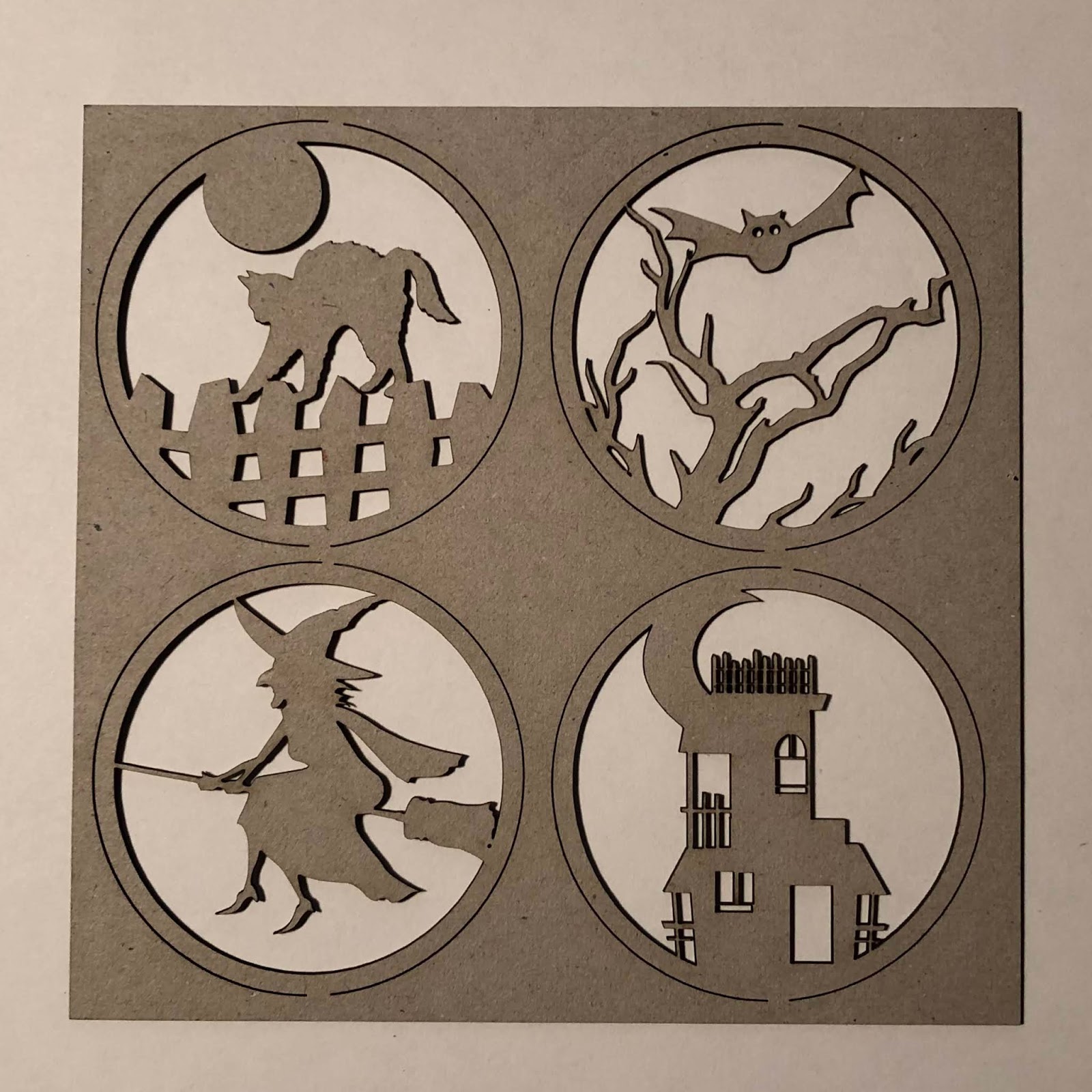
Gypsy Soul Laser Cuts has introduced a line of artist trading coin covers in various styles. They range from Alice in Wonderland to seasonal, including holiday sets. I look forward to using some of these in a traditional manner, but I thought it would be fun to use them as focal points for rosettes and attach them to sticks, creating wands. I begin with GSLC trading coin covers Halloween. The set includes four different designs.
I paint the witch coin cover with black soot paint on both sides and allow to dry. Once dry, I add a layer of glue to the central design and coat it with distress glitter. The designs have some intricate parts, so be sure to use a fine glitter so that the beautiful details can be seen.
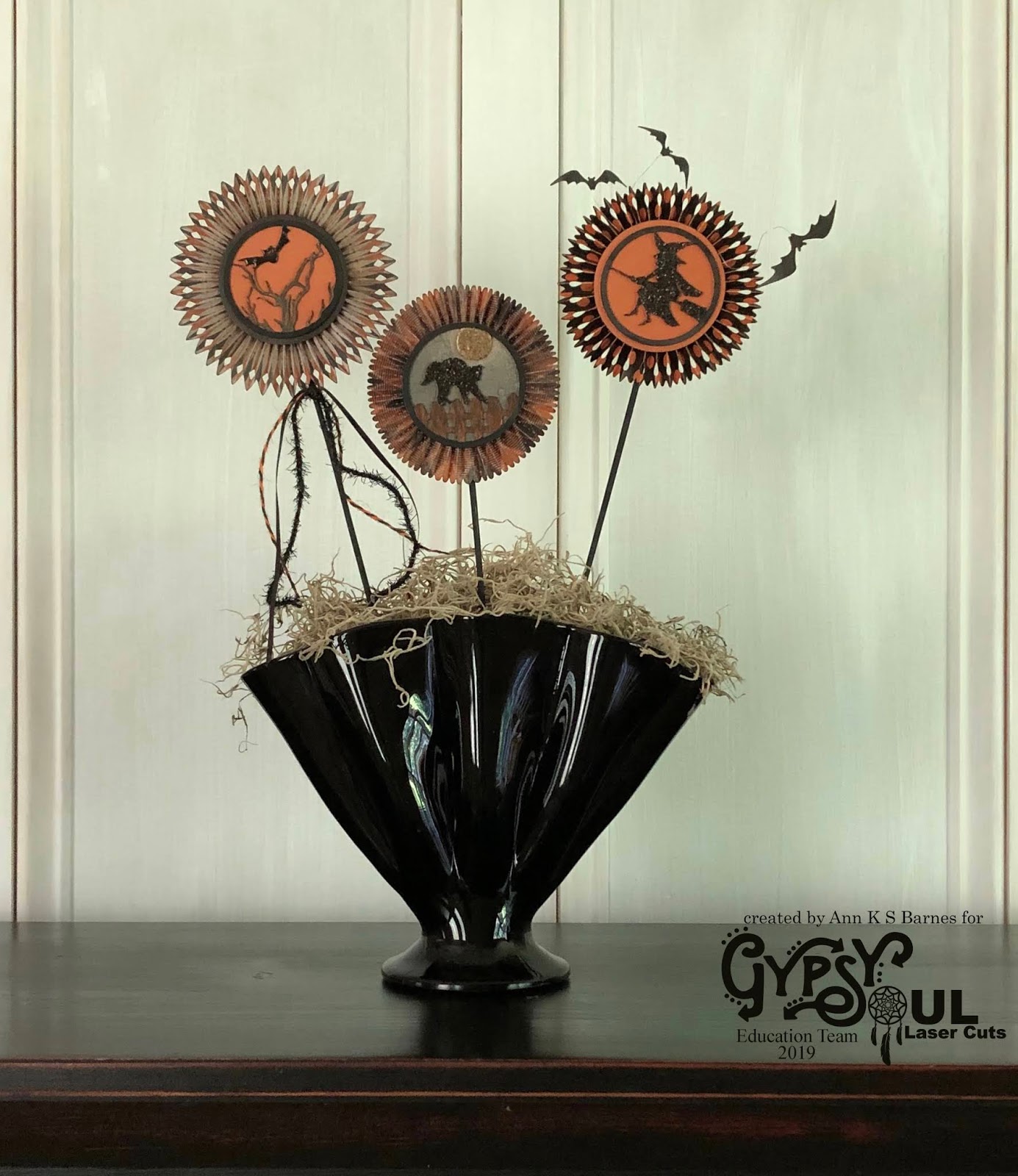
Using a paper rosette cutting die, I cut multiple pieces from the Halloween Kraft Stash paper pad. The edges are inked with black soot distress ink and the die cut strips are glued end to end creating a circle. (tip: be sure that when gluing the strips, you keep the all decorative edges along the same side.) I then die cut a circle for the center that is larger than the trading coin cover. This piece will cover the open area within the rosette, as well as provide a base for the trading coin cover. A line of glue just along the outside edge of the back of the circle allows it to adhere to the rosette when "flattened."
Before attaching the glittered trading coin cover, I flip the rosette over and finish the reverse side. This step is much easier, and a lot neater, when completed before the glittered piece is attached to the front. I attach a wooden skewer stick to the rosette with tacky glue. (tip: be sure that the stick extends to the top of the rosette ring, this gives it more stability.) I have also added some die cut bats on thin wire to my piece, the wires slip through the gaps that the folds of the rosette create, and are attached with collage medium to the back side of the circle. When the adhesive has dried, the back of the rosette is closed up with another circle die cut. I used a patterned paper for this to add interest to the back side.
The wand is flipped back over and the finished trading coin cover is attached with collage medium. Decorative trimmings can be tied around the stick at the base of the rosette.
Each of the rosettes are created in a similar way, simply adjusting the size, or number of layers.
The cat on a fence trading coin cover is finished with a combination of paints, embossing powder, and glitter. I always love painting faux wood, and think it looks perfect on the fence portion. What Halloween piece would not be complete without a black cat? I added a dot of gold to simulate the glow of the cat's eye. The moon is coated with embossing ink then covered with ancient amber embossing powder and heat set. The trading coin cover is attached to a kraft stash circle that has been inked with black soot distress ink to simulate a midnight sky.
The largest rosette creates a perfect backdrop for the bat and tree trading coin cover. Using distress paints in shades of brown, I paint the tree limbs to look dimensional. The bat is painted with black soot paint and then covered with a thick layer of glossy accents and allowed to dry. Gold paint lines the interior rims of the bat eye openings. The trading coin cover is adhered atop two layers of Kraft paper stash and finally attached to the center of the rosette. Halloween trimmings are tied around the skewer at the base of the rosette.
The fourth trading coin cover is used to embellish a small round die cut box that contains candies. I die cut the box and cover it with Halloween patterned papers. This trading coin cover is finished using embossing powders. The piece is first painted with black soot paint, then each interior element is coated with embossing ink and covered with embossing powder, and heat set. I love the glow of the moon over the haunted house silhouette. Once it has cooled, the coin cover is attached to a circle of orange kraft stash paper that has been inked to simulate a spooky sky. Miniature bat die cuts are attached randomly within the coin circle. Additional bat die cuts are attached around the box sides, unifying the design.
 Gypsy Soul Laser Cuts also makes incredible, chunky artist trading coins. They are sold in sets of three. I have used them for another project that you can find here. The artist trading coins would also be perfect for layering beneath the trading coin covers.
I really enjoyed creating these fright night fancies, I hope that you may consider alternate ways to use the Gypsy Soul Laser Cuts trading coin covers. They are the perfect size to add to just about any project, or even use on their own.
Thanks so much for taking the time to stop by, I truly appreciate it.
~Ann
 xxx
 
I am entering this project in:
 Simon Says Stamp Monday Challenge: Animal Magic
(Cat and Bats)


Gypsy Soul Laser Cuts:
Trading Coin Covers Halloween

other supplies :
Distress Collage Medium: matte
Distress Glitter: black soot
Distress Ink: black soot
Distress Paint:
black soot, ground expresso, vintage photo, walnut stain,
Eileen Hull / Sizzix Scoreboards Die: bigz xl cookie box
Seth Apter / Emerald Creek Baked Texture Embossing Powder:
 ancient amber. eclipse
Glossy Accents
Tim Holtz Ideaology:
Paper Stash Classic Kraft, Kraft Stash Halloween, Paper Stash Halloween, Trimmings Halloween
Tim Holtz / Sizzix Alterations Dies:
bat crazy, mixed media halloween, rosette set
Wire: 32 gauge
Wooden Skewers
Xyron Creative Station Lite

Wednesday, May 1, 2019

may day basket

Happy May Day!
 When I learned that my first Gypsy Soul Laser Cuts blog post for this month was on May 1st, the thoughts that came to mind were centered around May Day Celebrations. Memories from my childhood of dancing around the Maypole and crowning the May queen; as well as the tradition of hanging May baskets, are the inspiration behind todays project.
I begin with a Gypsy Soul Laser Cuts Bagatelle Box 1.5 x 4. There are many size options available for this box. I choose this size to accommodate a basket handle that would be able to hang from a door knob (as is tradition) when complete. I paint the top and bottom edges of the pieces with antique linen Distress paint and allow to dry. The interior faces of the box sides are then covered with decorative paper to mimic a pretty spring lining for the "basket." I prefer to adhere the decorative papers prior to constructing the box. When this method is selected, be sure to keep the interlocking tabs free from paper. The photograph below shows how I have covered some of the surfaces.
Once adhesive for the lining pieces is dry, I glue the box together and set aside. 
Next, I ink pieces of Distress woodgrain cardstock with Distress Oxide ink in scattered straw and fossilized amber. Drying the inks with a heat tool between layers. When I am satisfied with the coloration, I then use Distress Ink in brushed corduroy and walnut stain to give the cardstock the look of real wood by accentuating the wood graining.
These pieces are cut into strips that will be woven together to create the "basket."
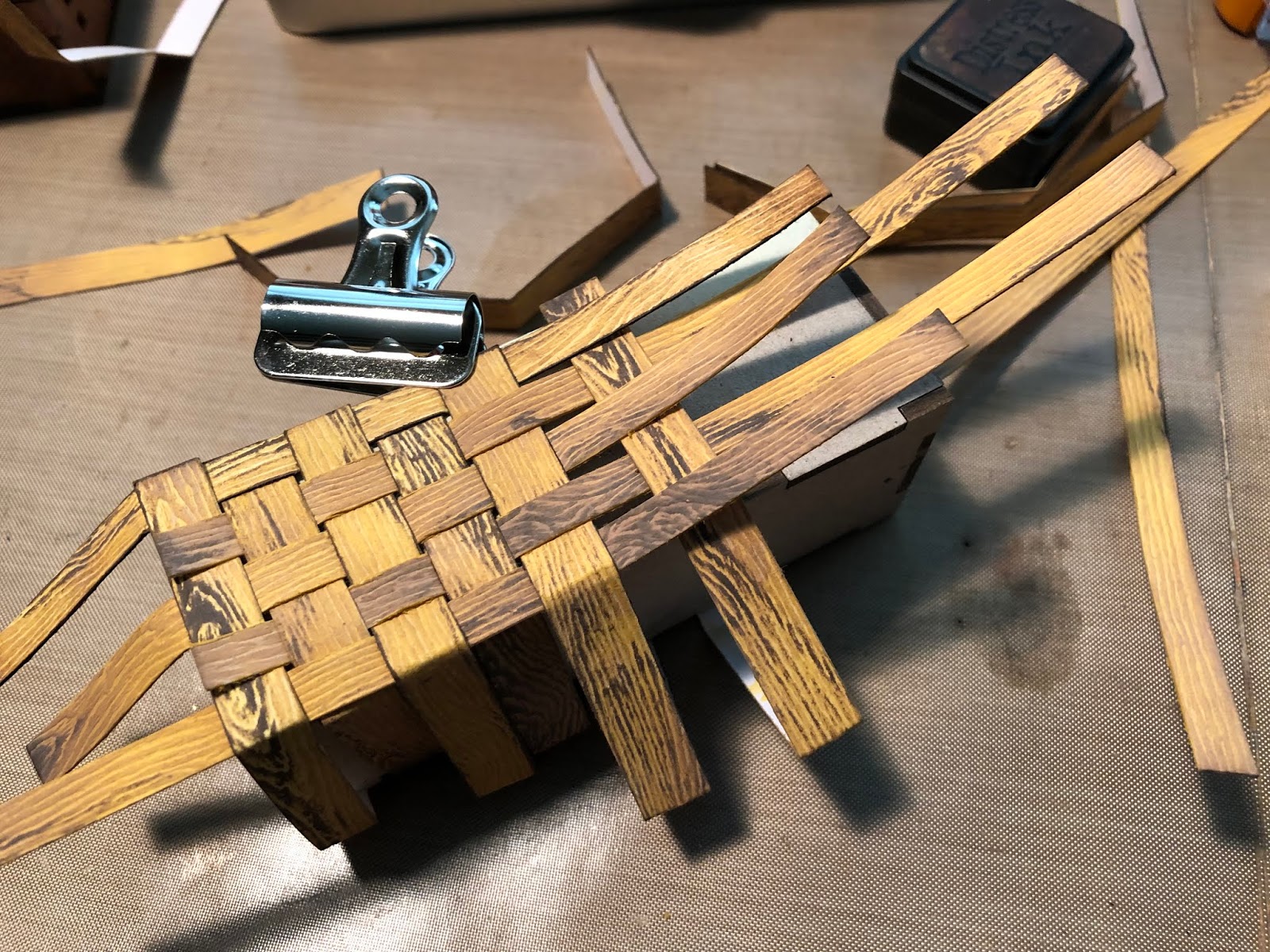
The edges of each strip are inked with coordinating inks to hide the white core that is exposed when the strips are cut, then I begin to weave the pieces together, using the bagatelle box sides as guides.
I continue the weaving to completely surround the box base. 
I then cover the top edges of the bagatelle box with 1/8" strips of the inked woodgrain cardstock. With the basket portion complete, it is time to begin filling it with flowers. Tradition has it that May baskets are filled with the blooms gathered at the end of April's showers. To start, I use the fringing method to cut a piece of peeled paint colored card stock, creating a serpentine of "grass" that will assist in filling the basket. I add a thin line of quick dry glue along the bottom edge of the grass piece and secure it into place.
With the grass in place, I begin arranging the flower pieces that have been colored with Distress inks in shaded lilac, wilted violet, and bundled sage, and the stems painted with peeled paint Distress paint I also add some leafy stem diecuts that have been painted with Distress paint in peeled paint color. All of the various pieces are glued into place. 
The final step is attaching the basket handle. Due to the length of the basket base, as well as wanting the basket to be able to hang from a door knob, as is tradition, I cut two strips of the same width from the remaining inked piece of woodgrain cardstock. (Note: I have inked both sides of one of the pieces of woodgrain cardstock so that when the underside of the handle looks the same as the top. This is important since the handle bends and slips into the sides between the box and the woven paper.) These two pieces are overlapped and glued together at the top. I add a stamped and colored butterfly to the handle to complete the project. 
I am off to deliver this May Day Basket to its special recipient, and carry on this wonderful tradition.
I hope that the coming days are filled with May flowers and perhaps they inspire you to create something beautiful. 
Thank you so much for stopping by, I truly appreciate it.
~Ann
 xxx   


supplies
Distress Archival ink: black soot
Distress inks:
black soot, blueprint sketch, brushed corduroy, bundled sage, dusty concord,
shaded lilac, walnut stain, wilted violet
Distress Oxide inks:
brushed corduroy, fossilized amber, scattered straw
Distress paint:
antique linen, peeled paint
Gypsy Soul Laser Cuts: Bagatelle Box 1.5 x 4
Tim Holtz Ideaology: bouquet
Tim Holtz/Sizzix thinlits dies: flutter, garden greens
Tim Holtz/Stampers Anonymous stamps: flutter (CMS294)